
Your CBG Plant Will Fail: Not Because of the Digester But Because of the Biomass Pre-Processing Line
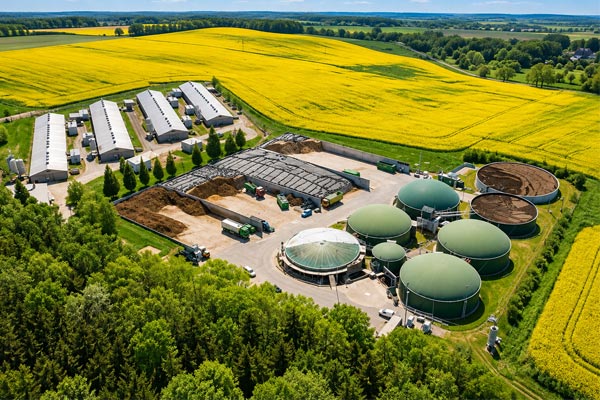
What this article covers:
- Why redundancy - two processing lines - beats one large line for uptime.
- Why shredder sizing for bale format variability prevents downstream bottlenecks.
- Why a bypass-capable dryer beats both full-time drying and no drying.
- Why hammer mills outperform extruders for paddy straw & cotton stalk at 10-15 TPD scale.
- Why densification is the buffer that keeps digesters fed 365 days a year.
The uncomfortable truth nobody talks about
Ask anyone about Compressed Biogas (CBG) plants in India, and the conversation lands in the same place almost every time: which digester technology should I pick, dry fermentation or wet, which OEM, and what is the retention time. Those are fair questions, but these are probably not the ones that actually decide whether a plant works successfully or not.
After reviewing multiple operating plants across different OEMs and different digester technologies, a different picture takes shape, and it is the one that the industry mostly skips. For CBG plants built on agri-residues such as paddy straw and cotton stalk (Press mud, Cow dung, Napier grass are different raw materials), efficient raw material collection and storage and cost-effective and reliable pre-processing are the factors that decide whether a plant succeeds or fails. In many cases, they matter more than the digester technology itself.
This is not a generic checklist. It's the mechanical and financial reasoning behind why each piece of the processing line is specified the way it is, based on what actually happens when agri-residue in all its inconsistency hits real equipment at commercial scale. The focus here is the processing side of that equation.
Sizing the line: Why redundancy beats scale
Most commercial agri-residue CBG plants coming up today sit in the 10 to 15 TPD range, which works out to a daily biomass feed requirement of roughly 80 to 120 tons.
The instinctive engineering response is one large processing line sized to match that requirement. In practice, that has proven to be the wrong call. What actually works better is two independent processing lines, each sized at 60 or 100 TPD (3 or 5 TPH running 20 hours a day) for 10 or 15 TPD plants, backed by a 1.0 or 2.0 TPH densification unit.
The logic isn't complicated. Biomass availability is never uniform through the year. Weather, season, and supply disruptions are a given, not an exception. A single large line, however well designed, is a single point of failure. Any breakdown, maintenance shutdown, or monsoon disruption starves the digesters directly. Two independent lines running in parallel mean that regardless of weather or seasonal swings, the digesters can be fed the quantity of biomass they need, day after day.
Equipment by equipment: What actually matters
1. Primary size reduction: Designing for unpredictable input

Agri-residue bales arriving at a plant gate are anything but standardized. The same plant site could receive any of the following:
- Small square bales of 15 to 25 kg
- Round bales of 200 to 350 kg
- Large square bales weighing 500 to 600 kg
Since there's no real control over which bale format shows up in the most economical manner, the shredding stage can't be designed around one format and hope for the best. This is where a surprising number of plant designs fail before they even get to the hammer mill. A shredder sized and geometrically configured for small square bales will jam, stall, or need constant manual intervention when fed a 500 to 600 kg large square bale. This mismatch shows up as unplanned downtime and inconsistent feed to everything downstream, including the hammer mill and dryer.
The right approach is a large-capacity, versatile shredder capable of handling all three bale types with equal effectiveness, meaning adequate infeed opening and drive torque to process the largest bale format without derating performance on the smaller ones. Getting this one decision right at the front of the line prevents downstream bottlenecks that would otherwise ripple through the entire process.
2. Drying: The step most plants get wrong in both directions

Strictly speaking, the CBG process itself doesn't demand dried biomass. That fact has misled a lot of plant designers into either skipping drying altogether or, at the other extreme, installing a full-time dryer that runs regardless of need. Both are expensive mistakes, and understanding why means looking at what moisture actually does inside a hammer mill.
Hammer mills reduce particle size through high-speed impact and shear: the hammer strikes the fibre, the fibre fractures, and the fragment passes through the screen once it's small enough. This depends on the material behaving in a brittle manner. Lignocellulosic fibre at low moisture is relatively brittle and fractures cleanly on impact. As moisture rises, the fibre turns more plastic and elastic. It deforms and bends under the hammer strike rather than snapping, and a meaningful share of the motor's energy goes into deforming the fibre instead of breaking it. The consequences stack up fast:
- Tonnage output falls, and specific energy consumption per ton rises, so you're paying more power cost to process less material.
- Screen blinding becomes frequent. Wet, fibrous strands wrap around the screen perforations and hammers instead of passing through cleanly, choking airflow and material flow.
- Particle size distribution widens and becomes inconsistent, with some material passing undersized while fibrous strands pass oversized. That matters downstream because inconsistent particle size affects hydrolysis rate and retention time inside the digester, and therefore biogas yield per ton of feed.
This is why equipment OEMs rate hammer mill throughput at a reference moisture, commonly around 15-20. That's roughly the point past which brittle fracture starts giving way to plastic deformation for most agri-residues. Real paddy straw and cotton stalk regularly arrive at 20 to 22 moisture, and for roughly 60 to 70 days a year, largely the post-monsoon and early winter harvest window, moisture climbs well past that threshold.
Full-time drying isn't the answer either. Thermal drying is one of the more power-and-fuel-intensive steps in the whole pre-processing line. Running a dryer year-round to cover a 60-to-70-day problem means paying that energy premium on roughly 80% of the year when the material doesn't need it at all, which is a direct, avoidable hit to the cost per kg of gas produced.
What works in practice is an online, optional dryer with a bypass system, sized and controlled on moisture feedback rather than run on a fixed schedule. Below roughly 20 moisture, the dryer is bypassed entirely, and material goes straight to the hammer mill. Above that threshold, the dryer comes online just long enough to bring moisture back into the brittle-fracture range before hammer milling. It's the only configuration that keeps hammer mill throughput and specific energy consumption on target through every season, without paying for drying capacity that sits idle most of the year.
3. Fine sizing: Why hammer mills win at scale on agri-residue

This is the equipment decision where plant owners most often get sold a technology rather than a solution, so it's worth going deeper than "hammer mills are better."
For the final sizing, the market broadly offers two families of technology. First are the hammer-milling lines, which reduce size through high-speed mechanical impact and shear against a screen/grinding bars and second is the Extrusion-based lines, which reduce size and structure the material through compression and shear as it's forced through a screw and die, often with some thermal or mechanical cell disruption built in. Both are legitimate technologies, and the right choice depends entirely on the feedstock you're actually running and at what tonnage. For agri-residues like paddy straw and cotton stalk at 10 to 15 TPD-plant scale, the balance tips clearly toward hammer mills, and the reasons are mechanical and economic, not anecdotal.
Starting with silica content and abrasive wear. Paddy straw carries high silica content, and total ash is commonly in the 14 to 18 ash range, where most of it is silica-based. Cotton stalk is a coarse, woody, high-lignin fibre. In a hammer mill, the wear parts exposed to that abrasive load are the hammers and the screen, both low-cost, standardized components that can be swapped or reversed in a matter of hours. In an extruder, the abrasive load acts continuously along the barrel and screw flights under pressure and shear, which are precision-machined components with far tighter tolerances. Wear here isn't a quick changeover. It's a costlier part, often with a longer procurement lead time, and any dimensional wear on the screw degrades extrusion consistency and throughput before it's even visually obvious.
Throughput scalability tells a similar story. Hammer mills scale in a fairly linear, well-understood way with motor power and screen area, so going from 3 TPH to 6 TPH is largely a sizing exercise. Extruders scale less gracefully. A single screw has practical limits on diameter and length before torque, wear, and thermal build-up become limiting, which often means running multiple extruder trains in parallel to hit the same tonnage. That adds capital cost, control complexity, and more points of failure, working against the redundancy and simplicity that is needed by the plant.
Then there's tolerance to feed variability. Bale format and moisture all vary day to day at the plant gate, so the fine-sizing equipment needs to absorb that variability without needing constant recalibration. A hammer mill's screen-controlled output size is comparatively forgiving of this. An extruder's throughput and output consistency are more sensitive to feed moisture, fibre uniformity, and uniform feed rate, which is also why extrusion tends to be a more natural fit for feedstocks like Napier grass, where moisture and fibre characteristics are far more consistent and controllable at source than they are for collected agri-residue.
Downtime economics close the argument. Given that two independent processing lines have the right architecture at this scale, the fine-sizing equipment on each line needs to be simple to maintain and quick to bring back online after routine wear. Hammer mills are built for exactly that kind of fast-turnaround maintenance. Extruders, with their precision-machined wear parts, are not.
None of this is an argument against extrusion technology in general. It has a legitimate place, particularly for more homogeneous, lower-silica feedstocks. But for agri-residue CBG plants running paddy straw and cotton stalk at commercial tonnage, hammer mills are the technically sound, economically defensible choice, and any pre-processing line for this feedstock category should be built around that fact rather than around whichever technology gets pitched the hardest.
4. Densification: The quiet game-changer

If there's one piece of equipment whose value is consistently underestimated, it's the densification (briquetting) unit. Its benefits go well beyond simply compacting material.
On the process side, briquetting causes lignin to break down and migrate to the surface of the material, which is a genuine advantage for the downstream CBG digestion process. On the storage side, densified material can be stored efficiently in a way raw biomass can't. A plant can plan for storage of even 1,000 tons of processed material in as little as 4,000 to 5,000 square feet, and that storage becomes the buffer that carries a plant through peak monsoon shutdowns or any downtime in the pre-processing line.
There's a resilience benefit too. In extreme scenarios, continuous heavy rainfall where moisture spikes so high that even extracting raw material from storage yards becomes impossible, densified briquettes serve as a reliable backup feed source. In this scenario, the processing line becomes irrelevant for a few days, and the stored briquettes keep the digesters running.
Putting it all together

Two independent processing lines with a versatile shredder, an optional bypass-capable dryer, a hammer mill, densification (briquetting), and storage: combine these and you get a pre-processing architecture robust enough to support near 365-day digester operation. That's the lifeline of the project, quite literally.
It's worth repeating that this covers only the processing side. If collection is managed well and this kind of processing architecture is in place, there's very little reason a plant should fail to feed its digesters consistently, year-round. Reliable feedstock access combined with a resilient processing line removes what has historically been one of the primary operational challenges facing agri-residue CBG plants in India.
The cost dimension nobody budgets for

There's a financial side to this that deserves equal attention. Power consumption in the pre-processing segment is often one of the highest cost components in the entire plant, approaching, and in some cases nearing, the power draw of the compression and gas-cleaning unit itself.
Run this segment inefficiently, and the cost impact isn't marginal. Plants operating with poorly designed or poorly run processing lines can easily end up spending an additional 2 to 3 per kg of gas equivalent purely on account of processing inefficiency. At a commercial scale, that's not a rounding error. It's the difference between a project that's financially viable and one that isn't.
The bottom line
For agri-residue-based CBG plants in India, the digester gets the attention, but the processing line determines the outcome. Every equipment choice on this line has a specific, defensible engineering reason behind it, not just industry convention.
Getting the architecture right, and understanding why it's right, equipment by equipment, is what actually stands between a plant that runs 365 days a year and one that doesn't.
Hi Tech Agro Energy Pvt. Ltd. designs and supplies biomass pre-processing equipment for CBG plants. The insights here are drawn from field experience and our own equipment deployments
For more details on pre-processing solutions for agri-residue-based CBG plants, you may click here.
Recent Posts
-

Best Air Pollution Control Equipment for Industrial Applications 2026
September 23, 2026 -
It’s Time for the Pellet to Shine
March 25, 2017 -

One Man’s Garbage is Another Man’s Treasure
June 09, 2018 -
Paddy Straw based Briquetting Plant in Punjab, India
April 03, 2018 -
Why Size Reduction Equipment (Hammer Mill) Is Important in 2026
September 23, 2026